
Research
Gene therapy research for Cockayne syndrome type B
There is no treatment for Cockayne syndrome today. Replacing the faulty gene is the most promising route to one — and it is the work your donations fund.
The idea behind gene therapy
Cockayne syndrome type B is caused by mutations in a single gene, ERCC6, which carries the instructions for the CSB protein. Cells that cannot make a working CSB protein cannot repair a specific kind of DNA damage, and the damage accumulates in every organ — most visibly in the brain.
Gene therapy aims at the cause rather than the symptoms: deliver a healthy copy of the gene into the child’s cells, so that they can make the protein themselves. The delivery vehicle used in most gene therapies that target the brain is an adeno-associated virus (AAV) — a virus that causes no known illness in people, emptied of its own genes and refilled with the gene the child needs. AAV is not risk-free: high doses can affect the liver, and safety is one of the things preclinical work has to settle before any child is treated.
Why type B is a hard target
An AAV vector can only carry about 4.7 to 4.9 kilobases of DNA. Experiments show that packaged vector genomes never exceed roughly 5.2 kb, and over-sized vectors are truncated and work poorly.1
The coding sequence of ERCC6 alone is about 4.5 kb — it almost fills the vector by itself, leaving nearly no room for the switches and signals a therapeutic vector also needs. By comparison, the coding sequence of ERCC8, the gene behind Cockayne syndrome type A, is only about 1.2 kb, which is one reason type A programmes have moved faster.7
Solving that packaging problem is precisely what current research is about — and there has been real progress.
What has been achieved so far
- 2026 — first rescue in an animal model. An AAV9 vector carrying the human CSA gene, injected into the brains of newborn mice modelling Cockayne syndrome type A, significantly extended their lifespan, with the protein distributed widely in the brain and no vector-related toxicity. Brain abnormalities did persist, as did changes in the liver. The authors present the work as paving the way for the first clinical translation of an AAV gene therapy for Cockayne syndrome.3
- 2026 — a promoter small enough for ERCC6. A research group including scientists at the University of Minnesota published a 126-base-pair mini-promoter, designed explicitly because ERCC6 leaves so little space inside an AAV. In the central nervous system it drove expression comparable to standard, far larger promoters, while staying quieter in liver and kidney.2
- 2024 — a better vehicle for reaching the brain. A study the association helped fund, published in the Journal of Translational Medicine by Dr. Pacak's group with Prof. Peter Kang, compared two AAV variants in mice: AAV-DJ delivered far more vector into the brain and spinal cord than the widely used AAV9, and left less behind in the liver and kidneys. For a disease of the brain, picking the right vehicle is half the problem.6
- Understanding the disease better. Recent work from the Nóbrega laboratory argues that Cockayne syndrome type B arises from the interplay of DNA damage, disturbed transcription and mitochondrial dysfunction — which matters for judging what a successful therapy must correct.4
No gene therapy for Cockayne syndrome is available to patients today, and none is in clinical trials. We say this plainly because families deserve honesty: this work is at the preclinical stage, and it needs sustained funding to reach a trial.
What our association funds
The Viljem Julijan Association was founded by parents, and every euro we raise for this campaign goes to research aimed at Cockayne syndrome type B. So far €2.1 million has been raised toward a €2 million goal.
In July 2023, the Algarve Biomedical Center Research Institute (ABC-RI) announced that Dr Clévio Nóbrega had received a project worth one million euros from the Viljem Julijan Association to develop a gene therapy for a rare disease — funding that followed his earlier CureCSB project, “Development of a Gene Therapy for Cockayne Syndrome Type B”, itself worth over a million euros. Dr Nóbrega described the aim as building a platform for developing gene therapies for rare diseases, unique in Portugal and innovative at European level.5
Our president, Dr Nejc Jelen, put it simply in that announcement: for this disease, with no cure or treatment and fatal until now, there was no hope for patients or families — and that is what this research is meant to change.5
Sources
- Wu Z, Yang H, Colosi P. Effect of genome size on AAV vector packaging. Mol Ther. 2010;18(1):80–6. PMID 19904234. https://pubmed.ncbi.nlm.nih.gov/19904234/
- Chauhan M, Daugherty AL, Khadir F, et al. Design and initial characterization of a novel mini-promoter for gene therapies targeting the central nervous system. Mol Ther Adv. 2026;34(1):201681. PMID 42137269. https://pmc.ncbi.nlm.nih.gov/articles/PMC13148911/
- Batista AR, Scholand AC, Callahan WS, et al. AAV-mediated gene therapy demonstrates phenotypic rescue in a mouse model of Cockayne syndrome. J Clin Invest. 2026 (online ahead of print). PMID 42531030. https://pubmed.ncbi.nlm.nih.gov/42531030/
- Afonso-Reis R, Madeira CR, Brito DVC, Nóbrega C. Insights into Cockayne syndrome type B: what underlies its pathogenesis? Aging Cell. 2025;24(7):e70136. PMID 40536083. https://pubmed.ncbi.nlm.nih.gov/40536083/
- ABC-RI. ABC-RI researcher receives 1 million euros to study rare diseases in children. 4 July 2023. https://abcri.pt/news/abc-ri-researcher-receives-1-million-euros-to-study-rare-diseases-in-children/
- Chauhan M, Daugherty AL, Khadir F, et al. AAV-DJ is superior to AAV9 for targeting brain and spinal cord, and de-targeting liver across multiple delivery routes in mice. J Transl Med. 2024;22:824. PMID 39237935. https://link.springer.com/article/10.1186/s12967-024-05599-5
- NCBI Reference Sequence NM_000124.4 (ERCC6, coding sequence 4,482 bp) and NM_000082.4 (ERCC8, coding sequence 1,191 bp). https://www.ncbi.nlm.nih.gov/nuccore/NM_000124.4
Our research teams
We have partnered with two research groups — at the Algarve Biomedical Center Research Institute in Portugal and at the University of Minnesota Medical School in the USA — which are working on gene therapy for Cockayne syndrome type B.
-
Dr. Clévio Nóbrega
Algarve Biomedical Center Research Institute (ABC-RI), Portugal
-

Dr. Christina Pacak
Medical School, University of Minnesota, USA
-

Prof. Peter Kang, MD
Medical School, University of Minnesota, USA
 Play video: Dr. Christina Pacak, Cure for Cockayne syndrome – type B
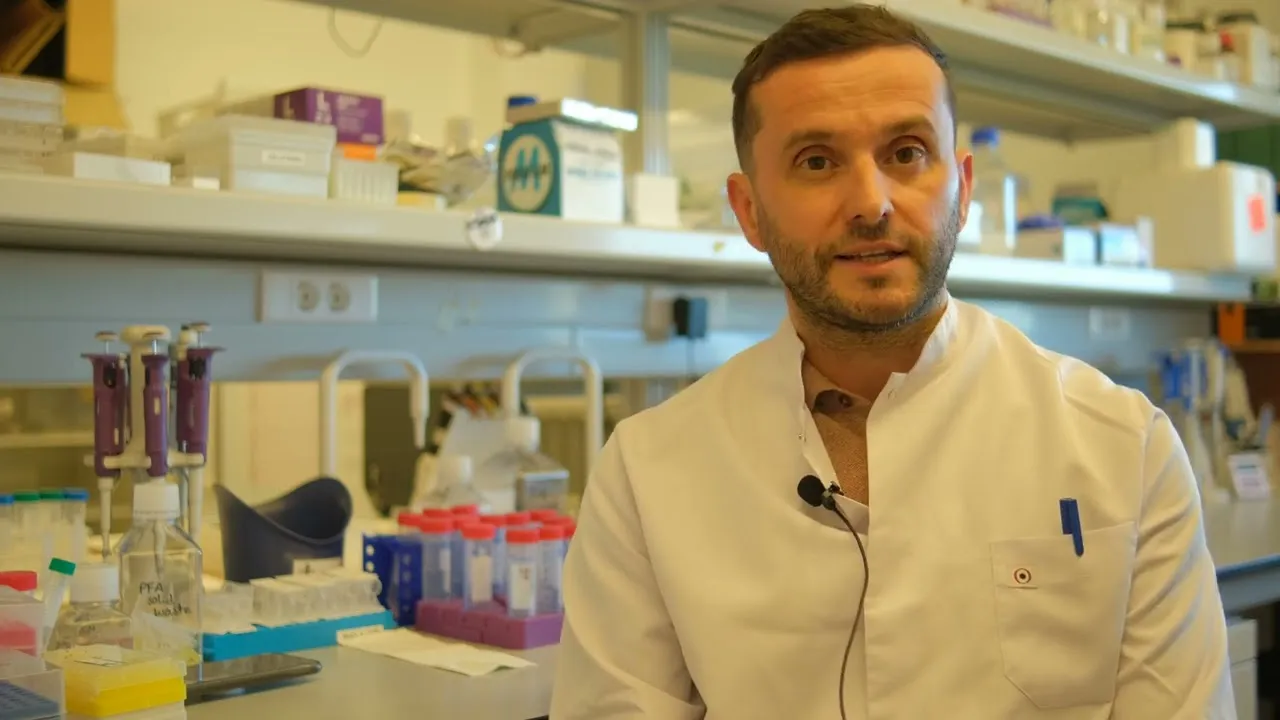 Play video: Dr. Clévio Nóbrega, Cure for Cockayne syndrome – type B
Research needs patience — and money
Your donation pays for laboratory work on a therapy that does not exist yet, for children who cannot wait.